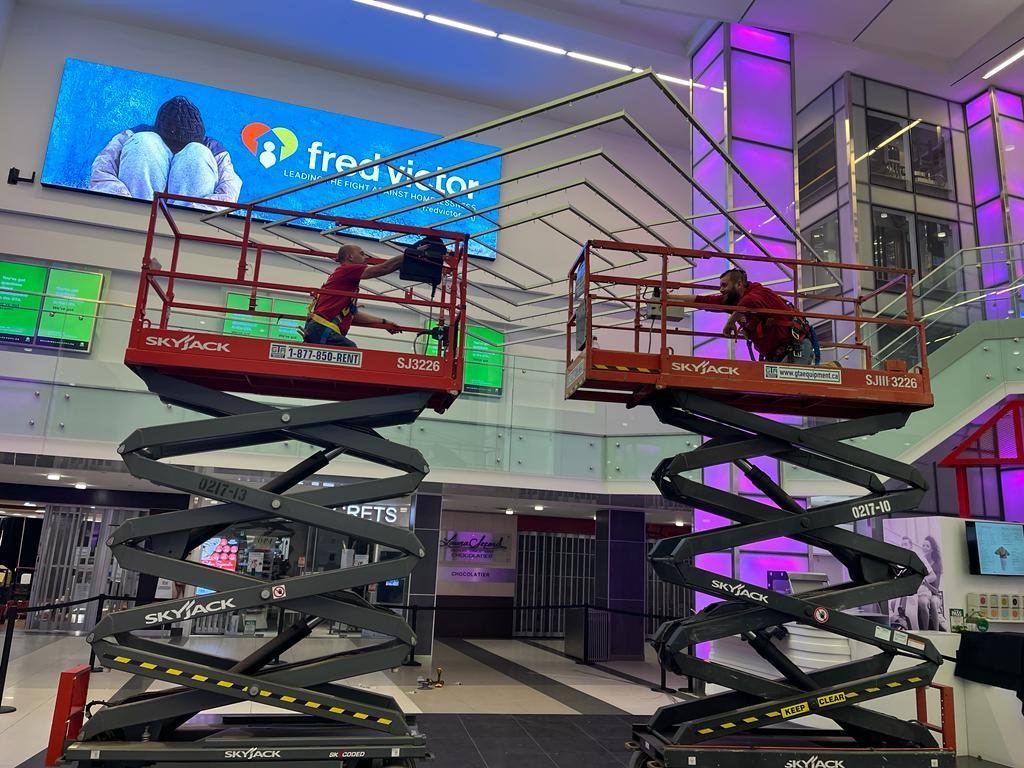
Scissor lifts are the safest way to get a person 20 or 30 feet in the air to work, and they are also the machine we see misused most often, because they look simple. Four wheels, a deck, two buttons. Most of the calls we get about a damaged lift, a tipped lift or a worker who got hurt trace back to the same handful of things, and none of them are complicated. Here is what Ontario expects of you and your crew before you run one, and what we tell every first time renter when the float drops it off.
Who is allowed to run it
Ontario's construction regulation, O. Reg. 213/91, requires that a worker who operates an elevating work platform be trained on it, and that a copy of the manufacturer's operating manual be kept on the machine. A scissor lift is an elevating work platform. There is no provincial licence, and nobody from the ministry hands out cards. The accepted way to meet the requirement is a training course built to the CSA B354 standard, which covers the different classes of aerial work platforms, the hazards, the pre-use inspection and a hands on evaluation. Workers come out of it with a wallet card that an inspector or a site super will ask to see.
The card is not the whole job. The regulation says trained on the machine, and the course is general. The person operating a lift for the first time should still get walked through the specific controls, the emergency lowering and the manual for the model in front of them. When we drop off an LGMG or Skyjack scissor, the driver goes through the controls with whoever is going to run it. Take the five minutes.
If your crew does not have cards, there are training providers across the west GTA that run the course in a day, and we can point you to one. Do not put an untrained worker on a lift because the job is short. That is exactly the job where it goes wrong.
Working at Heights is a different course
People mix these up. Ontario's Working at Heights training is required for construction workers who use fall protection equipment, such as a harness and lanyard. Elevating work platform training is about operating the machine. On a scissor lift with the guardrails up and the gate closed, the guardrails are the fall protection and a harness is not required by the regulation. If the work involves leaning over the rails, removing a rail section or any situation where a worker could fall from the platform, then fall protection comes into it and so does the Working at Heights card. A lot of general contractors simply require both cards and a harness on every lift on their site, which keeps it simple. Ask before the crew shows up.
The pre-use inspection
Every scissor lift gets checked before the first use of each shift. This is in the manual and in the regulation, and it takes a few minutes. Walk around the machine and look at the tires, the chassis for fluid leaks, the battery charge or fuel, the scissor stack for damage or missing pins, the guardrails and the gate, the decals and the manual in its holder. Then test it. From the ground controls and from the platform: raise, lower, drive, steer, the horn, the emergency stop and the emergency lowering. Lifts have a tilt alarm that stops the machine lifting on a slope, and you want to know it works.
Write it down. A simple daily log on the machine satisfies most site supers and gives you a record if something comes up later. If anything fails, tag it out and call us. We would rather swap a lift than have you run one with a stuck control.
Where the machine can and cannot go
An electric slab scissor like the ones in our aerial fleet is built for flat, hard, level floors: finished concrete, a warehouse deck, polished slab. It is not built for gravel, grass, a slab with the forms still on, or a floor with a step in it. The tilt alarm will stop you lifting on a slope, but it will not stop you driving a raised lift off the edge of a loading dock. Know the floor before the machine goes up.
Floor loading matters on upper floors and mezzanines. A 32 ft scissor weighs around 6,000 lb and puts that through four small tires. Suspended slabs and mezzanines have a rating, and the engineer or building owner can tell you what it is. If the work is outside on anything other than pavement, you want a rough terrain scissor with outriggers, or a boom, which we covered in scissor lift vs. boom lift.
Overhead, underfoot and around you
Look up before you go up. Sprinkler lines, ductwork, beams, open joists and overhead doors are where crush injuries happen on scissor lifts, because the operator is watching the work and not the ceiling. Set the height before you start, and do not drive at full height unless the route is clear and the floor is known. Keep the platform clear of material that can roll or slide, and keep the total under the capacity plate, which covers people, tools and material together. The narrow 19 and 26 ft units are rated around 500 lb, which is one worker with tools and a bit of stock. Two workers and a bundle of drywall is a bigger deck. We laid out capacities by model in the scissor lift height guide.
Cone off or tape off the area under the lift when other trades are working around it. Nobody walks under a raised platform, and nobody moves the machine while someone is on the deck without the operator knowing.
Never climb the rails
This is the one. A worker who cannot quite reach stands on the mid rail, or sets a bucket on the deck and stands on that. That is how people fall out of scissor lifts. If the platform height is short, the answer is a taller lift, not a step up. A 26 ft lift gives you a working height around 32 ft. If the ceiling is 34 ft, you need the 32 ft machine. The height guide above walks through how to measure the job, and we stock 19, 26, 32, 40 and 46 ft platform heights in Oakville, so the right size is a phone call away.
What gets a lift sent back early
A few things we see on returns that cost the renter money and could have cost more. Driving a raised lift into a doorframe or a sprinkler head. Running the batteries flat every day and never charging overnight, which shortens battery life and leaves the lift dead at 10 a.m. Loading the deck with pallets of material by forklift, which it is not rated for. Towing or pushing a dead lift with a skid steer. If a lift is not behaving, call the yard and we will deal with it. That is part of what the rental is for.
Booking a scissor lift in the west GTA
Tell us the height of the work, the floor it is sitting on, the tightest door on the way in and whether the crew has their cards. We deliver by float from the family owned yard on Speers Road in Oakville, with same-day and next-morning slots across Oakville, Burlington, Mississauga, Milton and Halton Hills. The driver walks through the controls on delivery, the manual is on the machine, and if anything fails the inspection we swap it. Request a quote or call (905) 580-7368.
