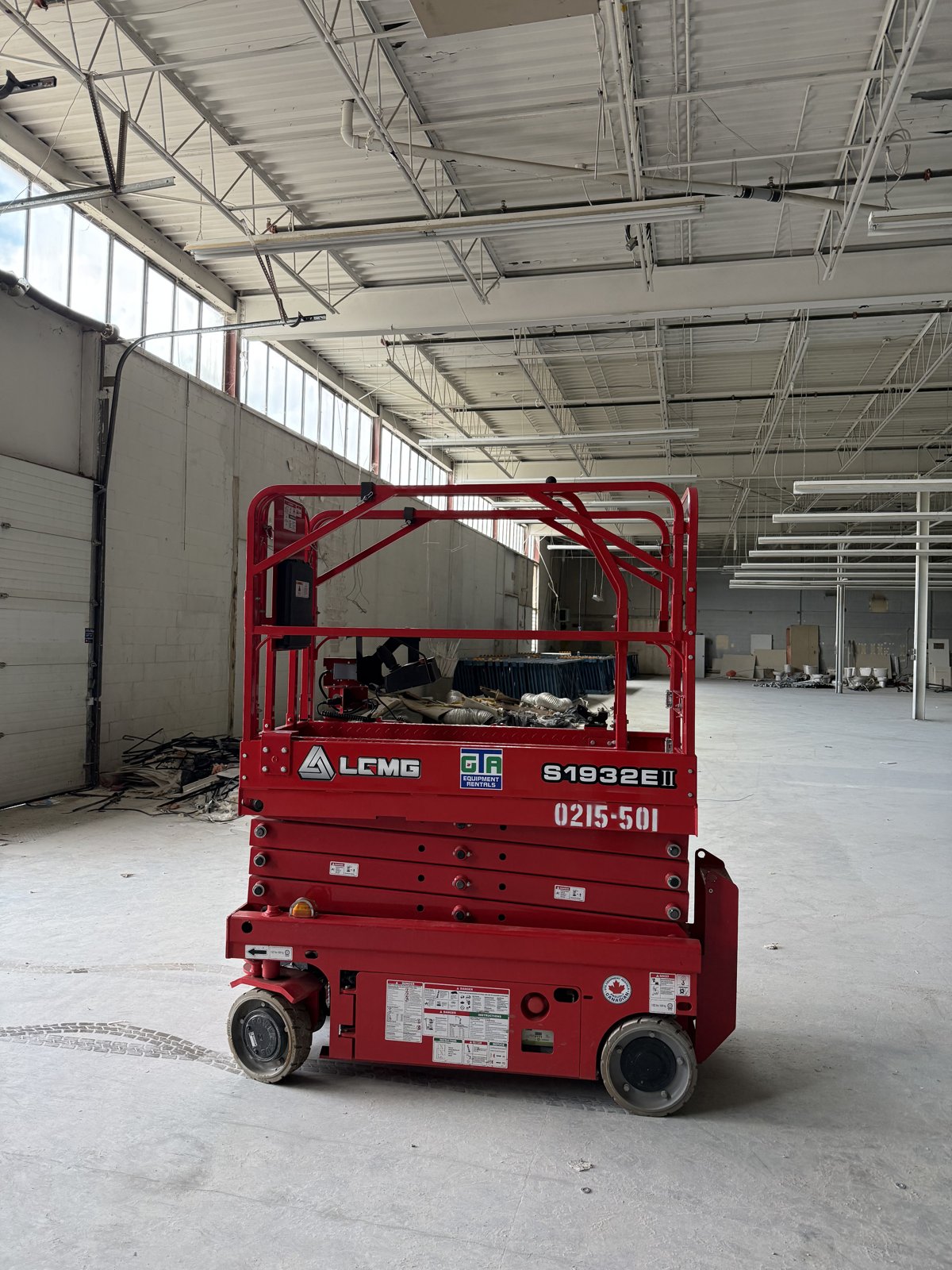
Scissor lifts are named by the height of the deck, not the height you can reach. That gap of about 6 ft (roughly 2 m) is where most sizing mistakes happen: someone measures a 26 ft ceiling, books a 26 ft lift, and spends the week on tiptoe. The wider picture is in the scissor lift rental guide. This one is just about height.
Platform height vs. working height
Platform height is the deck at full extension. Working height is platform height plus the reach of a person standing on it, which the industry pegs at about 6 ft. The four common sizes work out like this:
19 ft platform gives you about 25 ft of working height. 26 ft gives you about 32 ft. 32 ft gives you about 38 ft. 40 ft gives you about 46 ft.
Working height is a maximum, not a comfortable number. Work goes faster at chest height than at full stretch, so if the job sits right at the top of a lift's range, go one size up.
How to read the model number
The model name tells you how high it goes and how wide it is. On the LGMG units the first two digits are platform height in feet and the next two are deck width in inches. A 1932E2 is a 19 ft platform on a 32 in wide deck, the 2632E2 is 26 ft on 32 in, and the 4626E2, 4632E2 and 4640E2 are 26, 32 and 40 ft platforms on a 46 in deck. The E2 means electric. Skyjack writes the two numbers the other way around, width first: the SJ3219 is 32 in wide with a 19 ft platform, the SJ3226 is 32 in by 26 ft, and the SJ4626 and SJ4632 are 46 in wide at 26 and 32 ft.
Measuring the job
Measure to the work, not to the ceiling. Hanging T-bar, measure to the deck or joists you are hanging from. Ductwork, sprinkler mains or light fixtures, measure to the bottom of the duct or fixture, because that is where your hands will be. Subtract 6 ft and round up to the next size in the fleet.
Outside, add the drop. A facade panel 30 ft above a sidewalk that sits 2 ft below where the lift parks is 32 ft of work, and a scissor goes straight up without reaching out, so the deck has to sit close to the wall.
Measure the route in too: the tightest opening, including door hardware, and the lowest header the stowed machine passes under. With the rails folded, the 19 ft units clear a standard door frame.
Common sizes and what they fit through
19 ft, 32 in wide (LGMG 1932E2, Skyjack SJ3219). The most stocked lift in the yard. It rolls through a standard 36 in door and most passenger elevators, weighs about 3,000 lb, and covers nearly every office, retail and school ceiling in the west GTA.
26 ft, 32 in wide (LGMG 2632E2, Skyjack SJ3226). The same footprint with 7 ft more height, for gyms, dealerships and plaza units with high interiors. Still a single door machine.
26 and 32 ft, 46 in wide (LGMG 4626E2, 4632E2, Skyjack SJ4626, SJ4632). The warehouse workhorse. More capacity, room for two people and material, an extension deck to get over racking. Needs a double door, a roll-up or a dock, and weighs 5,000 lb and up.
40 ft, 46 in wide (LGMG 4640E2). The tallest electric scissor we run, for high bay distribution centres and mezzanine level structure.
All of these are indoor electric slab machines on non-marking tires. If the work is outside on gravel, grass or an unfinished slab, you need a rough terrain scissor from the aerial lift fleet. If you need to reach up and over something, that is a boom, which we covered in scissor lift vs. boom lift.
Capacity, workers and floor loading
The capacity on the plate covers everything on the deck: people, tools, the box of fixtures. The narrow units are rated around 500 lb, meaning one worker with tools or two people travelling light. The 46 in decks run 700 to 1,000 lb depending on the model, which is two workers plus material. The extension deck usually has its own lower rating.
Then look down. A 3,000 lb lift is fine on a slab on grade. A raised floor, a mezzanine or an older upper storey may not be, and an elevator has a posted capacity the machine has to come in under. If the job is not on a ground floor slab, tell us and we will match the lightest machine that still reaches. The floor also has to be level, since every electric scissor has a tilt alarm that stops it raising on a slope.
Delivery and float logistics in the GTA
Lifts go out by float from our family owned yard on Speers Road in Oakville, with same-day and next-morning slots across Oakville, Burlington, Mississauga, Milton and Halton Hills. The machine drives off at ground level, so we need a spot the truck can get into and a flat place to unload near the door it is going through. If it has to ride an elevator, say so when you book. Rates run by the day, week or month. The full electric line-up is on the scissor lift rentals page.
Quick pick by job type
Drop ceilings and T-bar in offices and retail: 19 ft narrow. Fits the door and the elevator, reaches a 10 to 14 ft ceiling with room to spare.
Warehouse racking and sprinkler work: 26 or 32 ft wide deck, depending on the top beam height. Racking over 30 ft means the 40.
Retail signage and storefront interiors: 19 or 26 ft narrow inside. Exterior pylon and fascia signs are rough terrain or boom work.
Painting: 26 ft wide for a warehouse wall so the paint and a second person fit on the deck. 19 ft narrow for occupied interiors.
HVAC and ductwork: measure to the bottom of the duct. Usually 26 ft in commercial units, 32 or 40 ft in high bay.
Exterior facade: rough terrain scissor on firm ground up to around 40 ft of platform. Anything higher, or anything you have to reach over, is a boom lift.
Tell us the height of the work, the tightest door on the way in and what the floor is made of, and we will put the right lift on the float. Request a quote or call (905) 580-7368.
