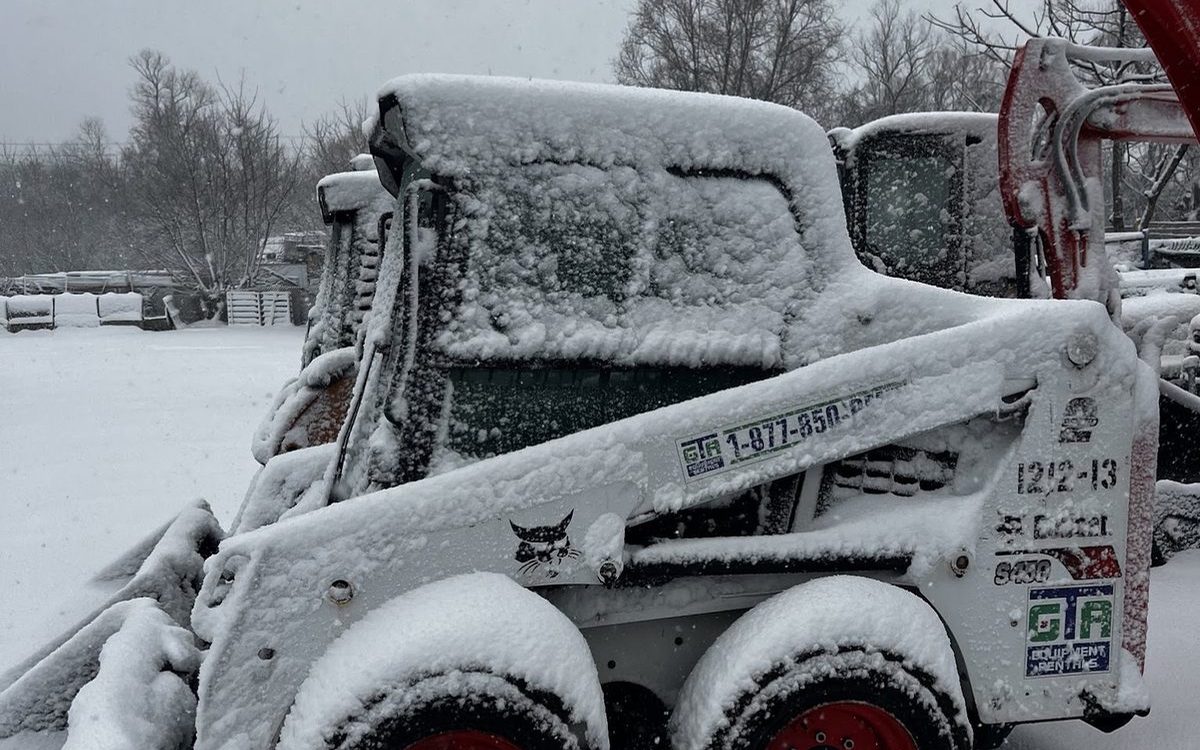
Work does not stop in the west GTA because it snowed. Foundations still get poured, interiors still get finished, and somebody still has to move the pile of material that was supposed to be gone in October. What changes is which machine you want, what you have to add to it, and how much of the day is spent dealing with the cold instead of the job. Here is what we tell people who are renting through the winter for the first time.
Heat is the rental that saves the schedule
Once the overnight lows sit below zero, concrete, drywall mud, paint, flooring adhesive and masonry all stop behaving. A construction heater is what keeps those trades on the calendar. The question is which kind.
Electric heaters are for enclosed interiors where you cannot have fumes: a finished unit, an occupied building, a small enclosure. Clean heat, no exhaust, limited output, and they need the power to run them.
Infrared heaters put heat on the crew and the surface in front of them rather than warming the air. Good for a trade working one area of an open floor.
Indirect-fired heaters, like the 400,000 BTU units in the heater and fan fleet, are the big ones. The flame is sealed off and the exhaust is ducted outside, so what enters the space is clean, dry heat in volume. This is what you rent to heat a whole slab under a tent, a hoarded floor of a building, or a tarped foundation for a cure. They burn diesel and they need to sit outside the heated space with the duct run in.
Sizing one is about the volume of the space, how well it is sealed and how cold it is outside. Tell the yard the square footage and ceiling height, and whether the space is hoarded, tarped or open at one end. We will size it with you, and we will tell you if you need two smaller units instead of one big one.
Winter concrete is a heat and time problem
Concrete that freezes before it reaches strength is ruined, and the Ontario spec for cold weather pouring is not a suggestion. The usual setup is a tent or tarped enclosure over the pour, an indirect-fired heater keeping the inside above the minimum for the cure period, and someone checking it overnight. Pair the heater with the right concrete equipment and book both for the full cure window, not just the pour day. Rushing the strip date to return a rental is how a slab ends up getting replaced in April.
Wheels, tracks and frozen ground
A wheeled skid steer is a pavement machine. On a frozen, plowed yard it works fine. On ice it spins, and on a site that is half frozen and half thawing it digs itself in. A compact track loader spreads the weight and keeps pushing when the surface is unpredictable, which is most of a GTA winter. If the job involves moving snow, pushing fill or grading in anything other than dry cold, go tracks. We laid out the general case in skid steer vs. track loader, and winter tilts the answer further toward tracks.
For snow specifically, a standard bucket will move it but a wider snow bucket or a pusher moves a lot more per pass. Ask what attachments are available for the machine you are booking.
Digging through frost
Frost in the GTA gets down a foot or more by January, and a mini excavator bucket does not go through it. A hydraulic breaker or a frost tooth on the machine does. If you are trenching for services or footings in winter, say so when you book and we will put the attachment on before it leaves the yard. The alternative is a heater and a tarp over the trench line the day before, which is sometimes the better call on a small dig.
What goes wrong with a rental in the cold
Diesel gels. Every diesel machine goes out with winter fuel from the yard. If you are refuelling it yourself, use winter diesel or an anti-gel additive, because a gelled machine is a dead machine until it is thawed and the filters are changed.
Batteries quit. Cold is hard on starting batteries. If the machine is sitting more than a few days, a block heater plugged in overnight, where the machine has one, saves the morning call.
Hydraulics are slow. Give the machine ten minutes at idle and work the controls gently before you ask it to do anything hard. Cold oil and full throttle is how hoses let go.
Tracks and tires freeze to the ground. Park on plywood or gravel, not on wet ground that will freeze overnight. Pulling a frozen track free in the morning is hard on the undercarriage.
Lifts in the cold. Electric scissor lifts lose battery range in the cold and should be stored inside. Diesel booms and rough terrain scissors are fine outside, but the platform and the steps ice up, so budget time to clear them.
Delivery when it snows
The float runs through the winter from the yard on Speers Road in Oakville across Oakville, Burlington, Mississauga, Milton and Toronto. What stops a delivery is the site, not the weather: an unplowed entrance, an icy grade the truck cannot climb with a machine on the back, or nowhere flat to unload. Clear the route in and the drop spot before the truck arrives. If a storm is coming, call and move the delivery up a day rather than losing the morning after.
Book the heaters early
Heaters are the one category where the whole GTA wants the same thing the same week. The first real cold snap in November empties every yard in the region, and the people who called in October have them. If you know a pour or an interior finish is landing in December, get the heater on the schedule now. Monthly rates make sense for anything that is running through the winter, and ongoing work is what leasing is for.
Tell us the job, the space and the dates. Request a quote or call (905) 580-7368 and we will match the machine and the heat to the work.
